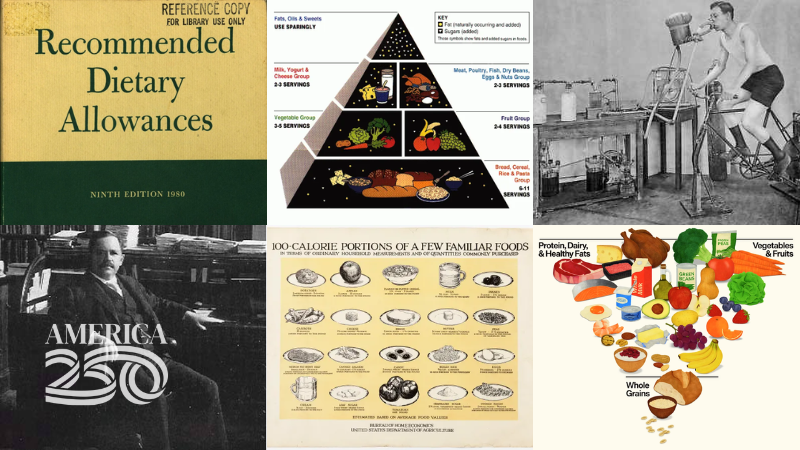
It may be hard to fathom today, but there was a time before protein-maxxing. A time before Make America Healthy Again. A time before soda pop became a fiber-packed treat.
For a good chunk of the last 250 years, Americans were blissfully ignorant about nutrition and healthy eating.
The presence of food was key to survival. The absence of it? Well, not so much.
Early notions of “food as medicine” began as Native Americans shared “herbal wisdom” with colonists, helping them survive a laundry list of maladies from snakebites and burns to childbirth complications and constipation, according to United Plant Savers, a medicinal plant conservation group.
But as a young America matured, healthy eating became politicized, paving the way over many decades for today’s Make America Healthy Again (MAHA) movement that is reshaping consumer demand and, with it, expectations on food manufacturers and foodservice operators.
“The MAHA movement is best viewed as the latest chapter in a long history of shifting nutrition priorities,” said Dr. Joy Dubost, a food scientist, registered dietitian and regulatory expert who collaborates with IFMA The Food Away from Home Association as a subject matter expert. “A century ago, the focus was vitamin deficiencies, later it was fat and cholesterol, then obesity and added sugars. Today, the emphasis has shifted to ultra-processed foods, and ingredient safety and transparency."
President Lincoln created the U.S. Department of Agriculture (USDA) in 1862, assigning management of the country’s food and nutrition to a government body.
About 30 years later, the USDA embarked on early nutrition research, with the earmarking of $10,000 in the agricultural appropriations bill for “food investigations.”
The man at the center of those early investigations was Wilbur Olin Atwater, the USDA’s first chief of nutrition investigations and a pioneer in human metabolic research. We have Atwater to thank for figuring out how many calories per gram are in proteins and carbohydrates (four) and how many are in fats (nine).
“These calorie values were known as the ‘Atwater Factors’ and pioneered the Nutrition Facts label that can be found on food containers today,” according to the USDA’s Agriculture Research Service.
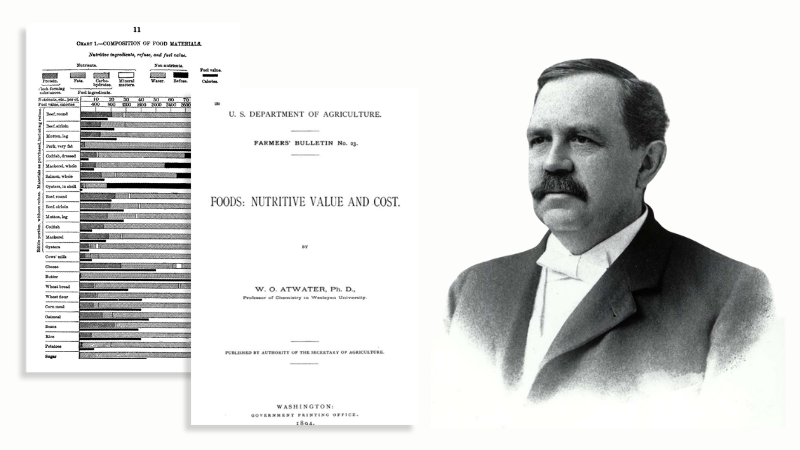
Photo: W.O. Atwater's 1894 USDA Farmers' Bulletin No. 23, "Foods: Nutritive Value and Cost" (USDA)
It was Atwater who wrote the USDA’s first dietary recommendations in 1894, published as a Farmer’s Bulletin. Vitamins had yet to be identified, but Atwater emphasized a proper balance of protein, carbohydrates and fats, all in moderation, as the foundation of good health.
“The evils of overeating may not be felt at once, but sooner or later they are sure to appear—perhaps in an excessive amount of fatty tissue, perhaps in general debility, perhaps in actual disease,” he wrote.
That opened the floodgates to further nutrition research.
Between 1910 and 1940, scientists identified vitamins and linked deficiencies in them to certain diseases.
This discovery changed modern food manufacturing, according to a report from the International Food Information Council (IFIC). By 1924, iodized salt was commonplace. In the 1930s, milk started being fortified with vitamin D. By the end of 1942, IFIC said, 75% of white bread sold in the U.S. was boosted by additions of thiamin, niacin, iron and riboflavin.
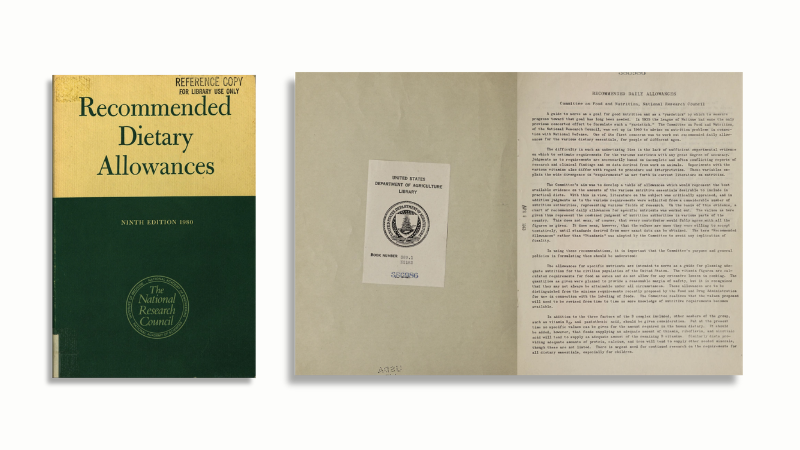
Photo: National Research Council. 1941. Recommended Dietary Allowances. Washington, DC: The National Academies Press.
Around that same time, during the height of World War II, the government released its first Recommended Dietary Allowances (RDAs), detailing the ideal numbers of calories and specific nutrients for the public to consume.
“While some of the rhetoric surrounding Make America Healthy Again may be more confrontational than previous nutrition campaigns, the underlying themes—greater transparency, concern about chronic disease and scrutiny of the food supply—are not new,” Dubost noted. “Historically, similar concerns have driven major shifts in food policy, from food safety reforms in the early 1900s to nutrition labeling in the 1990s.”
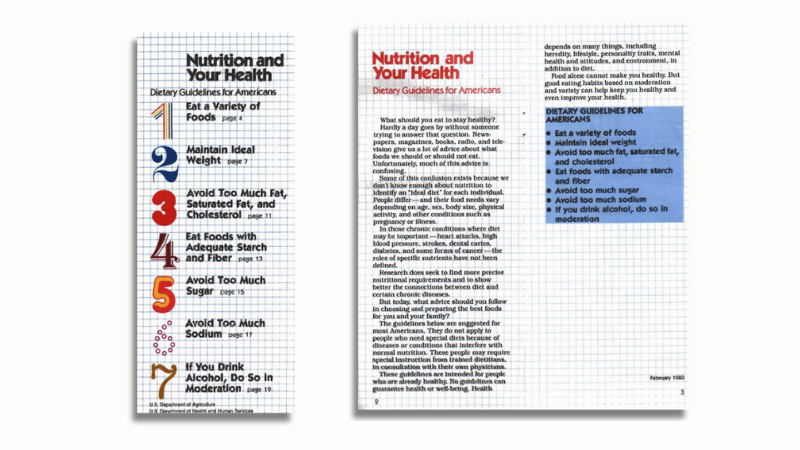
Photo: The 1980 Dietary Guidelines for Americans
Atwater’s cautionary echoes carried into the 1970s, when the government published its first “Dietary Goals for the United States” guidance, based on ballooning research that showed a correlation between chronic disease and overconsumption of certain foods containing fat, sodium and other indulgences.
By 1980, consumers had their first look at the “Dietary Guidelines for Americans,” which has been updated every five years since. Of interest to food manufacturers, the guidelines advised Americans to “avoid too much” fat, saturated fat, cholesterol, sugar and sodium. It also suggested alcohol in “moderation” (and just 2 ounces or less per day of the hard stuff for pregnant women).
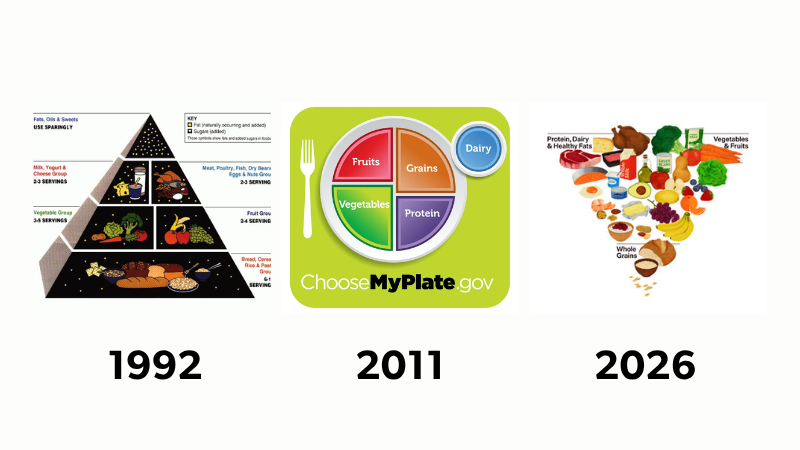
Photo: Photo: The 1992 Food Pyramid, 2011 My Plate, 2026 Dietary Guidelines
The Food Guide Pyramid was born in 1992, providing a visual guide to “healthy” eating, with a recommended six to 11 servings of grains serving the as the base of the triangle, followed by fresh produce, meats and dairy, with fats, oils and sweets at the tippy-top.
By 2011, the pyramid was replaced with MyPlate, a sectioned icon with (larger) spots for grains and vegetables and smaller areas for fruits and protein, with a cup for dairy next to the plate.
The government’s latest nutritional guidance, released early this year, focuses largely on “real food” and limiting processed items.
"For food manufacturers and foodservice operators, the message is that consumer expectations are evolving again,” Dubost said. “The companies that adapt successfully will be those that anticipate demand for greater transparency, simpler ingredient statements and clearer health positioning while continuing to deliver convenience, affordability and taste.”
This has led to a race among some food manufacturers to reduce or eliminate some synthetic ingredients from their rosters, while some states and municipalities eye crackdowns on ultra-processed foods.
For its part, the government is still mulling its definition of ultra-processed food.
“The real question is not whether the [MAHA] movement is extreme, but which elements ultimately become institutionalized through policy and consumer behavior,” Dubost said. “Thus far through the influence of MAHA, we're seeing a broader definition of healthy emerge. Consumers still care about nutrition, but they're increasingly evaluating foods through the lens of ingredient transparency, processing and the perceived necessity of individual ingredients."
Heather Lalley is the director of communications for IFMA The Food Away from Home Association. A lifelong journalist, Lalley has previously worked with industry publications including Restaurant Business, CSP Daily News, Supermarket News and Foodservice Director.