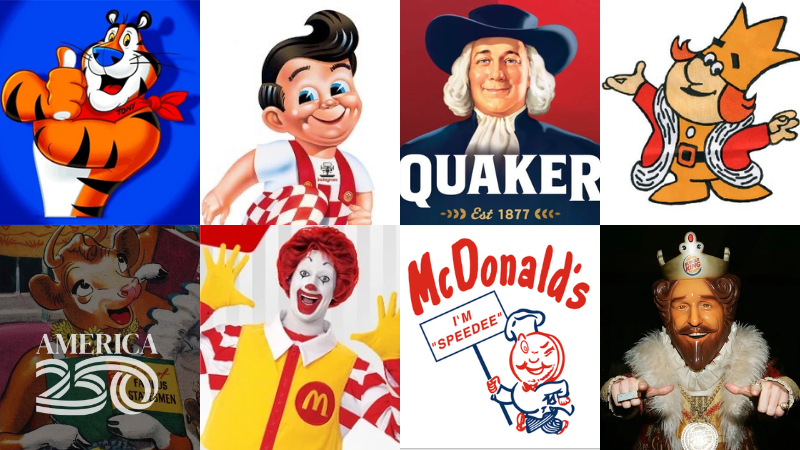
Not to mention cows, Quakers and tigers with a booming voice. Join us for a look back at some of the mascots who’ve shaped the business.


In the late 1940s, two veterans of Southern California’s vibrant restaurant scene decided to brainstorm a dining option unlike anything the business had ever seen. The craziest aspect of their quest was a determination to sell a quality hamburger for 15 cents, but that was far from the lone idiosyncrasy of the brothers’ plan.  


The youngest, who went by Dick, had a knack for marketing, and he intended to ensure the venture stood out among the dozens of grab-and-go joints that were springing up at the time. It was his idea to nestle the restaurant between two gigantic golden arches intended to convey the “M” of “McDonald’s,” and to invent a playful nonhuman representative of the brand who’d connect with children and adults alike. He insisted on having a mascot. 


But if you think that was the birth of Ronald McDonald, you’re likely unfamiliar with the parade of mascots who’ve come and gone in the food-away-from home business since the first burger patty was dropped on a grill.  


Ronald wouldn’t lace up his oversized brogues for nearly another 20 years. McDonald’s original mascot, and apparently one of the first seen in the restaurant business before tv advertising became the marketing norm, was a winking burger-headed cartoon figure in chef’s whites and a toque.  


Speedee would remain McDonald’s mascot into the early ‘60s, when he was benched in part because of confusion with one of the cartoon front persons who became big stars in the early days of tv, Speedy Alka Seltzer. A mascot’s life can be tough off camera.  


Even Ronald McDonald has suffered his share of career setbacks. He would go on to become one of the most recognized icons in the world—better-known among the children of some markets than Santa Claus. Yet he’s been sidelined several times by the chain that grew from the groundbreaking prototype Dick and Mac McDonald opened in 1948. 


He also suffered from at least one severe miscast. As part of an effort to whet McDonald’s appeal to adults, the chain put Ronald in dapper street clothes and showed him participating in adult activities like shooting pool. It did not catch hold. 


He couldn’t even claim to be the industry’s lone clown mascot. Ground Round, a regional full-service chain marketed to families, had Bingo, a human-sized fixed character situated at the entrance. He could inflate balloons, but his career ended tragically. When Ground Round shifted up-market in the 1990s, Bingo didn’t make the cut. As an executive put it at the time, “We blew up Bingo.” 


The history of FAFH mascots is clearly a tale rich in emotion and intrigue, yet it’s seldom been told. We’re sharing a bit of it here as part of our ongoing series on the industry’s contributions to a nation celebrating its 250th birthday. For better or worse, those gifts include birthing some of the best-known mascots the U.S. has seen. 


“Nothing’s better for thee than me” 

Speedee may have been an early restaurant mascot, but the use of a personified icon to represent a brand was already common by then in the larger food industry. Among the first is believed to be Quaker Man, the fictional personage whose image adorned containers of Quaker Oats-brand oatmeal as early as 1877. And he’s still the cereal’s retail pitchman. He’s supposedly an elder of the Quaker church, which found a safe haven in the colony of Pennsylvania.  

He seldom has speaking parts anymore, but those of a certain vintage will likely remember Quaker Man’s catch phrase, “Nothing’s better for thee than me.” 

Elsie the Cow

Among the best-known food mascots of the 20th century—and arguably the most famous bovine in the business until the Chick-fil-A cows came along—was the actual heifer and subsequent cartoon version known as Elsie. She was the beast-ification of Borden Dairy Co., a company that tried repeatedly to buy McDonald’s in its early days because of the astounding number of milkshakes that were sold under the Golden Arches. 

Elsie got her start as part of a quartet of cartoon cows. A spotlight was turned on the cattle upon which they were based during the 1939 World’s Fair in New York City, where Bordon was touting a multi-cow milking system. A cow named Elsie continued to promote the technology in the years afterward, appearing at events throughout the country. Her three herd mates apparently didn’t make the cut, even after Elsie reverted to a cartoon depiction again.  

She did share the limelight with her purported husband, Elmer the Bull. He became the spokes-steer for Bordon’s chemical division, the producer of Elmer’s Glue and other adhesive products. 

Tony the Tiger

The big cat also started out as one of a promotional foursome—in his case, a quartet of zoo critters who helped to introduce Kellogg’s Sugar Frosted Flakes in the early 1950s. But Tony quickly emerged as the Justin Timberlake of the group, outshining Katy the Kangaroo, Elmo the Elephant, and Newt the Gnu. His catch-phrase, of course, was “They’re gr-r-r-reat!” 

Tony was named after an Anthony on the creative team at Leo Burnett, Kellogg’s ad agency at the time. The Striped One originally walked on all fours, was much skinnier, and had a different-shaped head. 

He’s still sounding his trademark assessment of Kellogg-brand cereals today. 

The Big Boy

The pompadoured lad in red-checkered overalls may be one of the most resilient mascots ever to serve the business. The few remaining Big Boy restaurants aren’t exactly on the brink of surpassing Chick-fil-A in sales, yet the Big Boy icon is still a cultural reference point, a la the Austin Powers movie.  

The character’s nerdiness made him a camp figure that young knuckleheads enjoyed stealing, right up to current times.  

The inspiration for the pudgy fella was reportedly a 6-year-old resident of Glendale, California, named Richard Woodruff. The youngster wandered into a restaurant called Bob’s Pantry, where proprietor Bob Wian was trying to come up with a catchy name for a product he was adding to the menu, a two-patty sandwich that would be the industry’s first double burger. Wian greeted Woodruff with a hearty, “Hello, big boy!”, and a lightbulb went off. The sandwich became the Big Boy, the signature of the like-named chain, and the mascot was cast as a caricature of the young Woodruff. 

The Burger King

Like James Bond, the mascot for the Home of the Whopper has gone through multiple iterations, starting with a cute, pudgy cartoon royal in the 1950s and culminating in what may be the creepiest mascot the industry has known. That version, which first appeared in 2003, featured a regent in stereotypical royal garb, his wooden face sporting a never-changing grin that looked as if it came from a carnival’s House of Horrors. 

It was off-putting by design. The then-owner of BK wanted to reach the same young men who had turned wise-ass stunt shows like “Jack Ass” and “America's Funniest Home Videos” into major tv hits. 

That King also had a bit of Zelig to him. He appeared without any mention or acknowledgement in the background of a televised prize fight and the Belmont Stakes. 

That feature of the regent was reportedly retired this past March after a 70-year career in advertising.

Who are we missing?

Even a partial tally of the other fictional characters who’ve graced FAFH marketing strongly suggests the industry is and remains a hotbed of mascot activity. The examples range from family members (Wendy, mascot for the Wendy’s burger chain, was inspired by the daughter of chain founder Dave Thomas) to whatever Domino’s Noid character was supposed to be (the lop-eared being lived to wreck the chain’s pizzas). 

We’ve seen a rodent take a star turn (Chuck E. Cheese, for the pizza and games chain of the same name), along with an oversized bee (The Jollibee bee), a Kentucky colonel, an orb-headed component of a toy (Jack in the Box’s “CEO”), and cows who don’t agree with the recommendation from Robert F. Kennedy, Jr. that Americans should eat more red meat (the Chick-fil-A cows.) 

For all we know, some will likely still be around when the nation celebrates its 300th birthday. 


As Managing Editor for IFMA The Food Away from Home Association, Romeo is responsible for generating the group's news and feature content. He brings more than 40 years of experience in covering restaurants to the position.


Sponsored by

Media Sponsorships America250

The series will run through July, the 250th anniversary of that initial step toward the creation of the United States of America. Interested in sponsoring installments of our special report on 250 years of American dining?

Some key FAFH figures of the last 250 years were real clowns

Not to mention cows, Quakers and tigers with a booming voice. Join us for a look back at some of the mascots who’ve shaped the business.

Thomas Jefferson: Author, politician, founding foodie

A pivotal force in forming the United States 250 years ago, the philosopher-farmer also helped American dining break free from Britain’s influence.