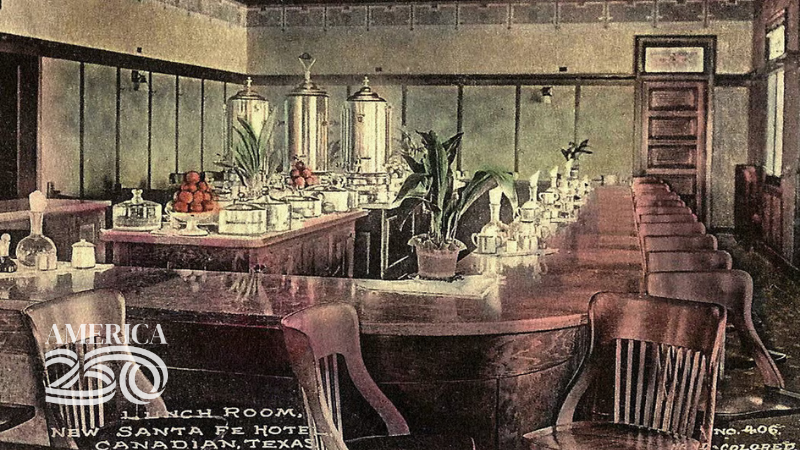
Postcard photo of the lunchroom of the Santa Fe Hotel at Canadian, Texas, 1913 via Wikimedia Commons
The industry grew in its early days literally alongside railways. No dining establishment was more famous than the nation’s first restaurant chain, Harvey House.
Any drive-thru restaurant is a reminder of the foodservice industry’s interdependence with the automobile. Dimmed by history is the symbiotic relationship enjoyed by the business decades earlier with another signature mode of American transportation, the railroad.
The connection took time to materialize. As more track was laid in the mid-nineteenth century, travelers either brought their own food or settled for what local opportunists peddled for a few cents. Most historical accounts describe the fare as unappetizing if not inedible, consisting largely of scraps from the entrepreneurs’ own dinner tables. In those pre-refrigeration days, freshness was hardly a given.
The situation changed as railroads continued to roll westward and journeys lengthened. Entrepreneurs awoke to the opportunity. Indeed, the ongoing advance of the iron horse would give rise in the first few decades following the Civil War to what is widely believed to be the nation’s first restaurant chain, a string of 47 trackside establishments known as Harvey Houses.
A few remain in operation, including an updated cafe version at the historic Bright Angel Lodge on the rim of the Grand Canyon. Several have been turned into museums or curio shops playing off the brand’s nostalgia.
The restaurants, often sitting cheek-to-jowl with hotels and gift shops run by the same company, were early proponents of the notion that the middle class was the mass market to target. They offered three meals a day at prices well under a dollar.
A full breakfast, for instance, might cost around a quarter, starting with a stack of pancakes for 15 cents. Steak and eggs were a specialty.
A scan of menus from the nineteenth and early 20th centuries suggests meatloaf was a signature of the operation, along with freshwater fish sourced locally, such as trout.
A major point of difference was the service. The waitstaff of each establishment consisted exclusively of what were called Harvey Girls, a crew of young women in their mid-teens through their 20s. Eventually about 5,000 women would work for the chain, each under contract for at least a year.
Although the outfits chosen for them by management could not be called lewd by any stretch, they did accentuate the servers’ figures. But the women were held up as pillars of virtue. They lived at the site of the restaurants, with the longest-tenured among them serving as house matron.
The residents had to abide by a strict curfew. Visits by gentlemen callers were chaperoned, and management would dismiss the women if they married less than a year after starting their jobs.
The restaurants relied on the most advanced communication technology of its time, the telegraph. A branch would be alerted by a station up the line that a train would be approaching and when they could expect it. The heads-up allowed the staff to prep accordingly.
Fred Harvey’s vision
Harvey Houses were the brainchild of Fred Harvey, who’d deserve his own wing if the food-away-from-home industry had an entrepreneur’s hall of fame.
Born in London on the cusp of the Victorian Age, Harvey emigrated to the U.S. as a teenager to make his mark on the world. His first steps toward fame and fortune were not auspicious; he landed a job as a pot scrubber in one of New York City’s fine-dining restaurants in the 1850s.
He immediately improved his lot by working his way up to server and then line cook, learning the business as he climbed. Harvey eventually opened his own place in the East but threw in the napkin at the start of the Civil War. His partner, a Confederate sympathizer, absconded with all the partnership’s funds.
Looking for something more stable post-war, Harvey became a railroad freight agent, a job that kept him bouncing from one rail depot to the next. He learned firsthand how few decent dining options were available to travelers, which got him thinking.
He convinced the Atchison, Topeka and Santa Fe Railway to let him and his partner open two restaurants about 280 miles apart on the company’s Kansas Pacific spur.
The dining options were a hit with travelers, who enjoyed few other amenities in their travels. Other restaurants would follow, along with hotels and gift shops. The expansion would continue into the 1960s. Along the way, Harvey added dining cars on the trains themselves.
He proved a natural marketer. Realizing the only way to increase his guest traffic was by convincing more Americans to travel by train, Harvey added Wild West-themed tourist attractions to his hospitality holds, romanticizing the Southwest in particular. Actors were hired to play Native Americans and cowboys.
His hotels started offering tours of Native American lands, with women in figure-accenting costumes serving as the guides. Never mind that the West depicted for the tourists was already fading into history.
Harvey also appreciated the value of word-of-mouth. He helped it along by selling postcards to promote the holdings of the Fred Harvey Co. The tactic was so successful that Harvey started selling promotional postcards on a wholesale basis to other hospitality businesses.
He would not live to see his venture grow to full bloom. Afflicted for years with severe abdominal pain, Harvey traveled back to his native London in hopes a renowned doctor there could help him. He was diagnosed with colon cancer and underwent surgery to remove a tumor. But the pain and affliction persisted, and he passed away in 1901 at age 65. The lore holds that his last words were, “Slice the ham thinner, boys,” a reference to a hot-selling ham and cheese sandwich on the Harvey House menu.
Oversight of the company was assumed by Harvey’s son, who would in turn name his son as his successor. Although business was eroded by Americans’ increasing reliance on cars, especially after World War II, Fred Harvey Co. would remain in operation until 1968, when it was sold to Amfac, the Hawaiian land-development company.
The Harvey empire would be immortalized in the 1946 movie musical “The Harvey Girls,” which starred Judy Garland. It enjoys a 100% rating on the movie-fan website Rotten Tomatoes.
This story is the latest in our ongoing series on the contributions of the food-away-from-home industry to a nation celebrating its 250th birthday. Earlier installments include a look at Thomas Jefferson’s unofficial role as America’s founding foodie, and the amusing world of FAFH mascots.
If you’d like to show your support for the industry by sponsoring any or all installments of the series, please contact edevine@foodaway.org for more information.