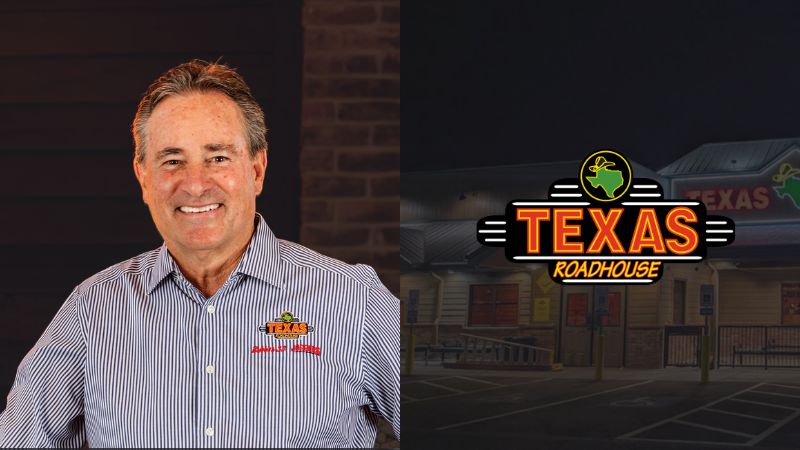
CHICAGO, March, 27, 2026 - A bright spotlight has been on Jerry Morgan since he stepped into the void left by the tragic death five years ago of Texas Roadhouse founder and longtime guiding force Kent Taylor. The preoccupation with what happened yesterday may be why so little notice has been taken of what Morgan is doing today as CEO to build on Taylor’s foundation.
“We have to evolve as a company," Morgan said during an interview minutes after appearing on stage as a keynoter at COEX. “Our culture is important. But our culture is being challenged by success. With success can come complacency and arrogance and bureaucracy. How do you stay hungry?”
The changes he sees as necessary for sustaining Roadhouse’s long run as a dominant brand in casual dining might draw a gasp from “Roadie Nation,” the brand’s employees and partners, acknowledges Morgan.
Take its reliance on sales of beer and other adult beverages, a key component of the Roadhouse experience.
“Drinking is changing,” says Morgan. “We look at mocktails. We may consider dirty sodas,” the mixed non-alcoholic drinks that blend different sodas and other ingredients together for a unique taste.
The menu may also have to evolve to bolster Roadhouse’s following among younger consumers as its core audience ages, he says in his rapid-fire speaking style.
“I’m a decisive person,” Morgan says. “The restaurant industry prepared me. You have to make decisions. If you make a wrong one, you change that decision and go on.”
But certain choices couldn’t be starker. One of Morgan’s oft-cited mantras is that he’s building on what Taylor created, not messing with its DNA. That means balancing change against the risk of eroding the Roadhouse experience.
Even when Morgan was running Roadhouses, he wasn’t a fan of having the staff occasionally break into a line dance when a foot-moving tune came on the playlist. But the quirk remains a Roadhouse signature.
So does its aversion to delivery, a principle Taylor laid out for investors in no uncertain terms. When competitors started mining gold through relations with third-party services like DoorDash, Taylor declared that he was not about to disappoint customers with cold food served in haphazard style.
Delivery remains off the menu in Morgan’s Roadhouse.
He acknowledges that his style is markedly different from Taylor’s. Take the way each interacted with investors as CEOs of public companies. Taylor famously refused to follow the suit-heavy dress code of Wall Street during financial presentations, opting instead for jeans and a cowboy hat.
Morgan acknowledges that he tries to be more tactful. But that doesn’t mean he’s less adamant than his successor about saying no to some of the investment community’s demands and recommendations.
“Could we run six-table sections instead of threes?” says Morgan, citing a cost-cutting tactic often suggested to Roadhouse management by investors. “Absolutely we could. But how would it affect the company and our culture?”
Yet he shares Taylor’s aversion to following empty customs, going even further than his predecessor in opting for comfort. Morgan often shows up for public events in a baseball cap, jeans, and a buttondown shirt.
“I do think I bring a little more passion to the business,” he deadpans. Minutes earlier, he’d been leading the nearly 700 attendees of COEX, few of whom worked for Roadhouse, in a loud, boisterous call-and-respond cheer from the stage for the company’s three brands. (In addition to Texas Roadhouse, the corporation runs a second casual-dining chain called Bubba’s 33 and a fast-casual burger-and-chicken sandwich concept called Jaggers.)
Morgan’s style is to keep no distance between him and the rank-and-file of Roadie Nation, says Travis Doster, Roadhouse’s chief communications officer. The CEO played on the corporate softball team, and he joined other Roadies in an ice water plunge to raise money for charity.
He was, after all, one of them for many years.
When Morgan was a youngster, his uncle bought two Burger Kings and asked his nephew to join the team.
“I was surprised at how much I really enjoyed it,” Morgan told the COEX audience. “I realized I could interact with customers, interact with employees, and be in charge of a business. It fit my personality.”
His tenure was cut short by the death of his uncle in a plane crash. Morgan rebounded and decided to find another restaurant job.
“I applied at Chili’s and at Bennigan’s,” Morgan continued, referring to the two groundbreaking casual-dining concepts. “Chili’s — no offense to anybody there — took a whole sheet of paper just to basically say, 'No, thank you.’ I have carried that with me for a long time.
“But I got hired at Bennigan’s and I did 10 years there,” he said. “It was phenomenal.”
It was there through mutual acquaintances that he met Taylor, another Bennigan’s operator at the time. Taylor already knew he wanted to start a chain, and Morgan was pulled in that direction along with some of his Bennigan’s partners.
He opened what was ironically Texas Roadhouse’s first unit in Texas (the chain’s home base was and remains Louisville, Kentucky), and the first unit opened in Indiana.
Morgan became an area developer, and his stores were among the highest-volume units in the system.
The sea change came in 2021. Taylor contracted COVID-19, which left him with severe tinnitus. He couldn’t stand the constant ringing in his ears and took his own life.
The chain founder had already been speaking with Morgan about moving to Louisville and joining Roadhouse’s corporate staff. Taylor had left a scrap of paper with Morgan’s name scrawled across it, a clear indication to Roadie management that Taylor wanted his Texas protege to be the company’s next CEO.
The deal was sealed when Morgan wrote a letter to the Roadhouse board, spelling out what he was committed to doing and pledging to carry on Taylor’s legacy. “I signed that letter promising to give them everything I had,” he recalls.
He acknowledges that not everyone was ecstatic about his appointment as CEO, “maybe because they wanted the job.”
But “I think I already hit the lottery,” he says. “I got to be part of something magical.
“There is responsibility that comes with that,” he comments, “But it’s an opportunity to have great impact. We’re really working on ‘27, ‘28, and where we want to be: Remain as true as we can to our past, focus on our present, and look at tomorrow.”
As Managing Editor for IFMA The Food Away from Home Association, Romeo is responsible for generating the group's news and feature content. He brings more than 40 years of experience in covering restaurants to the position.