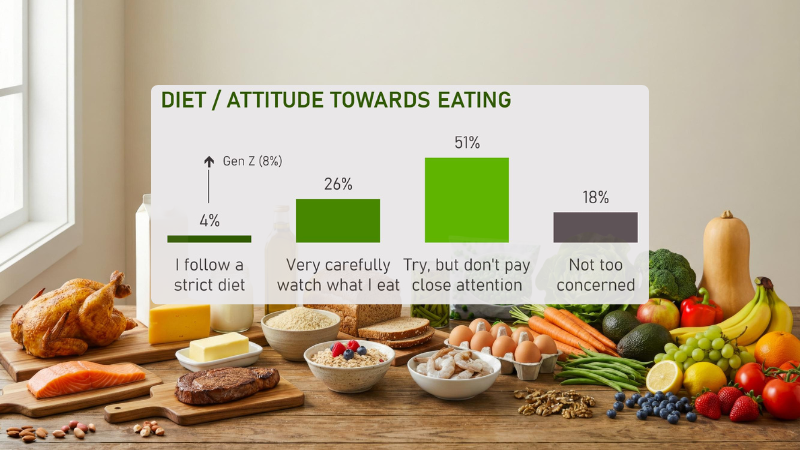
CHICAGO, April 6, 2026 — Younger consumers are the demographic group most likely to change what they eat based on the newly updated Dietary Guidelines for Americans.
That’s according to exclusive new consumer research from IFMA The Food Away from Home Association. The Association’s latest Consumer & Operator Research Group (CORG) report surveyed just over 1,500 consumers in February, one month after the revised dietary guidelines were released by the Trump Administration.
“The new dietary guidelines call for prioritizing high-quality protein, healthy fats, fruits, vegetables and whole grains—and avoiding highly processed foods and refined carbohydrates,” the government said in releasing the dietary rubric that’s in effect until 2030. “For decades, the Dietary Guidelines favored corporate interests over common sense, science-driven advice to improve the health of Americans. That ends today.”
About 10% of both Gen Z and millennial consumers said they always change their diet based on new information, a significantly higher percentage than Gen X or baby boomers. Another 23% of Gen Z-ers and 14% of millennials said they “often” make dietary changes after receiving updated information.
When it comes to learning about healthy eating, just over half (51%) of consumers said they rely on friends or family, followed by healthcare providers (44%), health-focused websites (38%), medical websites (31%), TV shows (27%) and social media or influencers (26%). Just 15% of those surveyed reported getting their nutrition information directly from federal agencies.
Fifty-nine percent of consumers said they either “strongly” or “somewhat agree with the new dietary guidelines, though 83% said they support the directive to consume more fruits and vegetables, followed by 77% who said they support reducing highly processed foods.
Less than half (41%) of those surveyed said they try to follow the Dietary Guidelines for Americans every day. Seventy-seven percent said they succeed most or some days in getting adequate protein and 76% said they consume the recommended amount of healthy fats, while just 53% said they are successful in meeting the dairy consumption guidelines.
Overall, 29% of consumers said they are “extremely” or “very likely” to adjust their diet based on the new guidelines, with 44% saying they would change produce consumption, 38% saying they’d boost healthy fats, 37% saying they intend to eat more protein, 35% saying they’d reduce highly processed foods, 34% saying they would eat more grains and 31% saying they would add more dairy to their diets.
“A considerable percentage of Americans, especially those from younger generations, are looking for guidance on how to eat healthier,” said Charlie McConnell, VP of Industry Insights, Education & Research for IFMA The Food Away from Home Association. “So, the new Dietary Guidelines for America offers suggestions of what foods and beverages they should eat more of, and which ones they should cut back on.”
The full report is available to Tier III Manufacturer members and operator members at no cost. A complete roster of the reports produced to date by the Association’s Consumer & Operator Research Group (CORG) can be found here.
Heather Lalley is the director of communications for IFMA The Food Away from Home Association. A lifelong journalist, Lalley has previously worked with industry publications including Restaurant Business, CSP Daily News, Supermarket News and Foodservice Director.