CHICAGO, May 13, 2026 — The federal government’s gauge of inflation during April brought bad news for the food-away-from-home business, even with the data showing the rate of increase for menu prices leveling off.
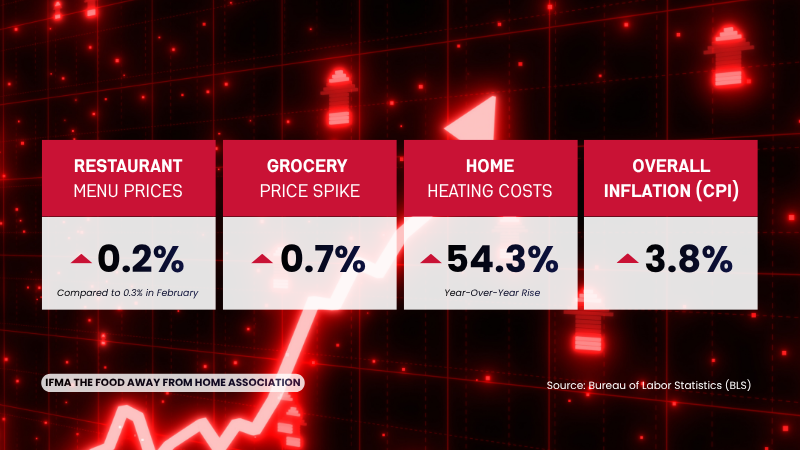
Those charges increased by an average of 0.2%, the same rate clocked by the U.S. Bureau of Labor Statistics (BLS) for March and a deceleration from the 0.3% reported for February.
Grocery prices, in contrast, spiked during the month, climbing 0.7%—a major leap in BLS terms. FMI – The Food Industry Association termed the increase “a significant jump” that will keep the food-at-home sector focused on managing costs.
A sharper increase in supermarket prices is usually good news for the FAFH business, narrowing the gap between what consumers pay for their groceries and the usually higher amounts they’d be charged for a meal prepared for them. With April’s upswing, the expense of a home-cooked meal is running about 2.9% above the average cost of a year ago, compared with a 12-month rise of 3.6% for food prepared by restaurants, onsite facilities and other foodservices.
But the explanation offered for the spike in retail prices points to a tougher sales environment for the FAFH industry.
The culprit cited by FMI and other sources is a continuing spike in energy costs, a result of the ongoing war with Iran and disruptions in oil supplies. BLS’ April figures show the cost of petroleum-based fuels climbed by 5.6% after soaring 21.3% in March.
With those increases, consumers are paying an average of 54.3% more to heat their homes and 28.4% more to gas up their cars and trucks.
Those inflationary rates were cited by a number of restaurant chains as a reason for weak traffic during the first quarter of the year. BLS’ Consumer Price Index figures for April suggest the negative influence on sales is extending into the second quarter.
The data also show restaurants are paying more to keep their lights on. Electricity charges rose by a sharp 2.1%, raising charges for the month by 6% above the level of a year ago.
In contrast, the cost of piped gas continued to decline, with a 0.1% decrease in April after a 0.9% drop in March. But prices remain 3% above what restaurants saw on their utility bills of a year ago.
Overall, the CPI rose 3.8% in April, the highest rate seen since May 2023. BLS noted that 40% of the increases in the gauge of costs can be traced to the spike in energy expenses.