Sponsored by P&G Professional
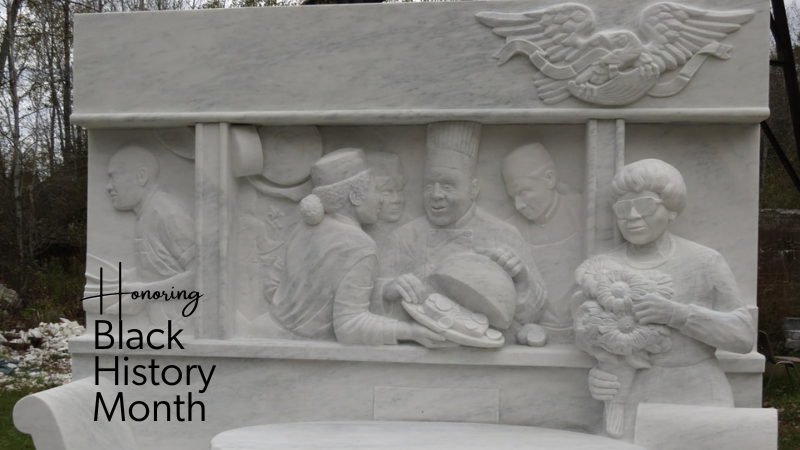
Photo Credit:Don Ramsey | Ernie Royal and wife Willa Sculpture
The story is as familiar to any student of the restaurant business as forks and napkins.
An underprivileged youngster lands the humblest of restaurant jobs at an age that would make his employment a crime today. The kid has a special spark and plenty of ambition, enabling him to navigate past one obstacle after another until he’s the owner-operator of a nationally renowned restaurant, wealthier than he and his doubters dared imagine.
The entrepreneur is recognized as an industry sage, serving on boards (including the National Restaurant Association’s), setting up scholarships, and emerging as a guru to up and comers who aspire to be just like him.
But there’s a major twist to this version of the story. Ernie Royal was Black, and he wasn’t about to let anyone who found that significant to hold him back. He would show them that ability, work ethic, and character were what determined success, not skin color.
What's more, he would do it in Vermont, a market as white as the sheep grazing in its meadows—and perhaps just as unenlightened. Prejudice wasn’t limited to the Jim Crow South in the 1950s and ‘60s.
Many would try to derail Royal simply because he wasn’t White. After years of working for others, including the U.S. Marine Corps, the Boston native opened a rotisserie-chicken and barbecue takeout joint in nearby Roxbury with his wife and business partner, Willa. Contemporaries from that time compare it to Boston Chicken, the concept that morphed into Boston Market.
The business was so successful that the couple wanted to expand into an adjacent building that happened to be for sale. But one lending institution after another refused to lend Royal the capital he needed. Never mind that he and Willa had each spent 20 years in the business by that point in 1955, with a successful business already to their credit.
But fate lent a hand. Saying he needed time “to cry in his beer,” Ernie took a restorative time out in Vermont, accompanied as always by Willa. They came across a shuttered restaurant on a major thoroughfare in the city of Rutland. The venture had failed, but the couple saw potential.
They offered to buy the place for what the seller was asking. But the price proved to be a moving target for Black buyers. Ernie had to sweeten his bid by $10,000 to get the property, basically giving the owner a deal he couldn’t refuse even if a Black man was involved.
Ernie and Will would open the place as Royal’s Hearthside in 1963, giving Vermont its first Black-owned restaurant. Ernie served as chef and Willa handled the business aspects, the roles they would fulfill for the rest of their lives.
The fine-dining restaurant became a hit, first locally, then as a regional must-visit, and finally as an establishment drawing national attention for its seafood, prime rib carved tableside, and Ernie’s signature popover rolls. Despite its remote location, the restaurant was added to the Michelin guide, the only restaurant in Rutland and its environs to earn the honor.
The community came to adore the Royals. Ernie, the man who couldn’t get a loan to expand a successful business, was named a director of the largest local bank.
Not everyone was open-minded. Hearthside employees from those days recall how suppliers peddling a product would ask Royal to summon the establishment’s owner—only to learn they were already speaking to him.
Customers could be more aggressive. Some refused to believe the Royals were the owners. In those instances, Ernie would gently tell the skeptics, “Well, I am. And if that’s a problem for you, there are a lot of other places to eat in Rutland.”
Beyond the restaurant, Royal pushed open doors that had long been closed to persons of color. He was the first Black elected to the NRA’s board and presumably the first Black director of the Rutland Regional Restaurant Association.
He and Willa would eventually start and fund a scholarship program so more members of minorities could attend the Culinary Institute of America.
Feeling they needed a break, the Royals sold Hearthside in 1984—to another Black couple. They helped the buyers, Al and Patricia Wakefield, acclimate to Rutland after living in New York City, and served as ambassadors so the new owners would be accepted by the community.
The Wakefields didn’t take to the restaurant business, selling Hearthside back to the Royals after just a year. Ernie and Willa would continue to run the landmark until Ernie’s death in 1994. Willa would pass a year later.
Never one to lunge for stardom, Royal may not be familiar to many in the restaurant business today. But his community made sure his impact on Rutland and local mores would never be forgotten.
Calling him “the Jackie Robinson of restaurants,” the town added a seven-foot statue of Ernie and an accompanying sculpture of Willa to the Rutland Sculpture Trail in 2024.