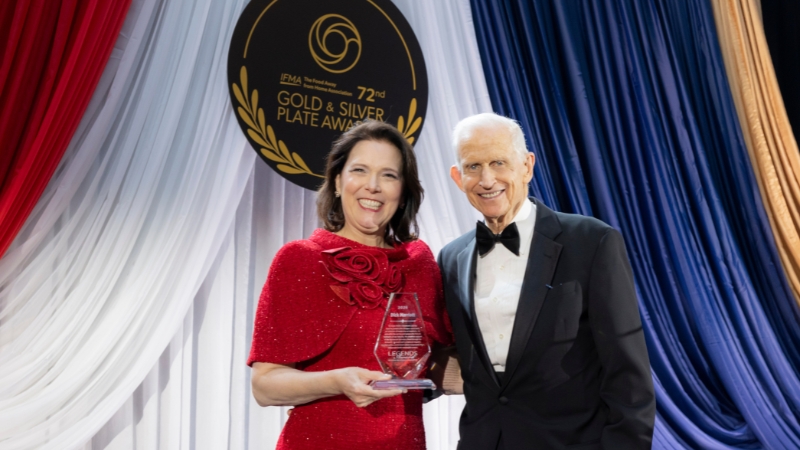
Left to right: Michelle Korsmo, CEO of the National Restaurant Association, Richard 'Dick' Marriott, 2026 Legends Awards winner
CHICAGO, May 19, 2026 — Every year, Richard “Dick” Marriott sends out about 1,000 Christmas cards. He estimates that half of them go to the close friends he’s made in the restaurant and lodging industries.
The line between his professional career and a personal life devoted to relationships—be it with his family, his church or his lifelong friends—isn’t a hard and fast one for Marriott. How could it be? The 87-year-old pegs his time in the business at 71 years, but a closer look at the numbers suggests it’s nearer to 80. He just wasn’t paid for the earliest years, when he’d accompany his legendary father on the latter’s daily inspections of the family’s restaurants starting at about age 7.
“It’s always been my life. I was born into it,” he remarked during an interview in his suburban Maryland home.
But it was hardly a sashay in velvet slippers from one cushy post to another.
“My brother would come to me with something that needed to be done, and I’d go and do it,” he explained, referring to his brother, Bill, seven years his senior. That fill-a-gap role took him from running several of the largest and highest-volume units of Hot Shoppes, the Marriott’s family-dining chain, to managing the architecture and construction of all the company’s hotels and restaurants.
He even oversaw the company’s theme parks, along with its extensive contract-feeding and inflight catering operations.
His long and successful leadership in just about every channel of the foodservice and lodging industries earned Marriott the selection by his fellow directors of the National Restaurant Association as this year’s Legends award winner. Prior winners have included his close friend and barb-exchange partner, Ted Balestreri, and Ted Fowler, the longtime past CEO of Golden Corral.
The honor was delivered by NRA CEO Michelle Corsmo during Saturday night’s Gold and Silver Plate Awards celebration, hosted by IFMA The Food Away from Home Association.
His selection afforded an opportunity for recounting a life that paralleled the rise of the modern hospitality industry, starting with those drop-ins with his father at a Hot Shoppes. The elder Marriott made a point of being in a restaurant just about every day.
“I’d cower in the corner and try to stay out of his way,” recalled Dick. “My father would inspect every inch of the restaurant and run his hand over every surface to make sure everything was clean and operating right.
“He demanded perfection so he'd get excellence,” Marriott continued. As for the thoroughness, “I learned the power of observation. How do you go through a restaurant and figure out what things are wrong with it?”
It wasn’t the only lesson imparted by J.W. “Willard” Marriott, who developed detailed guides on everything from how to wear a crew uniform to what servers should do to keep their breath fresh.
“The first thing my father taught me was how to sweep and mop the floor,” recalled Dick.
He would refine his restaurant acumen while working in the stores from age 16 on. Before that, he was
assigned to the family farm, a 4,000-acre working enterprise in rural Virginia where his duties included moving bales of hay. “We had a lot of hay,” Marriott remembered.
Family-run farms are usually exempt from regulations that prohibit youngsters under age 16 from working. Once he was legal, the teenaged Marriott shifted to the family’s Hot Shoppes restaurant chain, where he was paid 50 cents an hour.
Marriott gravitated toward the kitchen. He might flip 700 burgers a day and whip up serving after serving of Hot Fudge Ice Cream Cake, a Hot Shoppes signature.
It was not glamorous work, but Marriott cited it as an illustration of the hospitality industry’s under-appreciated superpower.
“If you want to do nothing more than flip burgers, that’s fine,” he said. “But I’d say there is no business on the planet where your career opportunities are greater than in hospitality, and in restaurants in particular. Most of my friends on the board of the National Restaurant Association started in the dish room, where I started. We started at the bottom and we worked our way up.
“You don’t need a college degree. You just need the right training and a willingness to work hard.”
Brotherly love
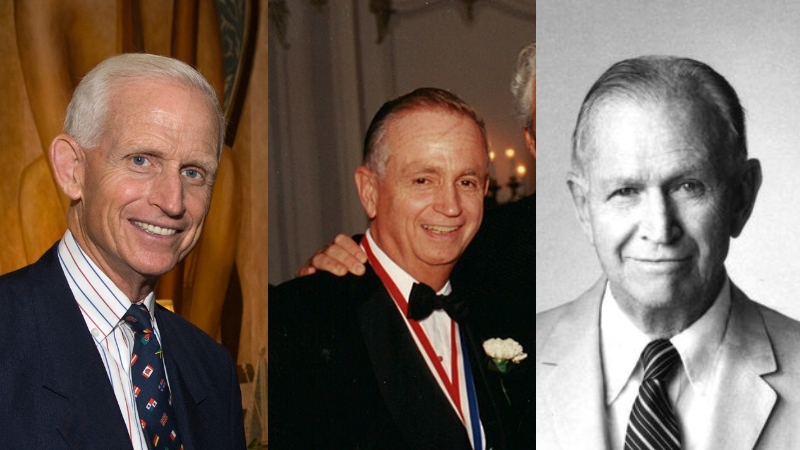
Left to right: Richard "Dick" Marriott, 2008 silver-plate award winner; J.W. "Bill" Marriott Jr., 1993 silver-plate award winner; and J.W. Marriott Sr., 1975 silver-plate award winner.
For much of the younger Marriott’s career, his boss was his older brother. But the age gap erased any strains that might have been expected and positioned Bill as more of a third parent, according to Dick.
“My brother was president of the company by the time I got out of school,” he said. “We never had a disagreement. He was the best man at my wedding.”
Dick was 18 when the family corporation diversified from restaurants into hotels. Afterward, Bill was drawn to the lodging side of the business, while Dick continued to focus on restaurants, though he didn’t assume his first management position until he’d earned his MBA from Harvard Business School.
The family business would become one of the nation’s largest operators of restaurants. The portfolio under Dick’s supervision would expand from the Hot Shoppes chain to Big Boy, Roy Rogers and Farrell’s Ice Cream Parlours. The corporation also ran franchised Popeyes restaurants as part of its management of highway rest stops in the Northeast.
The line between the brothers’ areas of focus were smudged when Bill approached Dick with an idea. “My brother called me and said, ‘We need someone to run our architecture and design operations.”
Dick had no education or experience in the field, but it was what the company needed. “I learned a lot about how to build hotels and restaurants," he recalled. “We must have had 30 or 40 architects; we were building so many.”
After mastering that assignment, Dick was asked to leverage his foodservice knowhow by heading up the company’s restaurant operations. “We must have had about 1,000 restaurants by then,” he said.
Dick found himself in a new role when the family corporation decided in 1993 to split into two companies. One would be a light-asset operator of hotels, led by Bill, and the other would be a holding company that owned the properties, Marriott’s travel-concessions business and its other foodservice operations. It would be headed by Dick.
“I got all the real estate,” he deadpanned, “and I got all the company debt.”
He remains chairman of Host Hotels & Resorts, now the nation’s largest real estate investment trust. He also serves as chairman of First Media Corp., a privately held broadcasting and investment company.
Marriott is kept busy by his involvement in a variety of community give-back efforts. “I get about 100 emails a day,” he says of the varied responsibilities.
Those charitable initiatives include the Richard E. and Nancy P. Marriott Foundation, named after Dick and his wife; and Bridges from School to Work, a charity that aims to provide young people with alternative career paths. In addition, he's chairman of the J. Willard Marriott and Alice S. Marriott Foundation, the charity named in honor of his parents.
“We have always considered one of our biggest responsibilities to be giving back to the community,” said Marriott. “We make all of our money from the community, so it’s only right we give back.”
He has also hosted the Richard E. Marriott Golf Invitational, an annual outing whose proceeds go to the National Restaurant Association’s Restaurant Advocacy Fund, for 29 years. The effort has raised $9 million in advocacy funds to protect and promote the hospitality industry’s interests.
This year’s event will be held Oct. 6-7 at Pinehurst Resort in Pinehurst, South Carolina, one of the nation’s legendary courses.
The fundraiser also provides grist for his playful back-and-forth with Balestreri, whose Ted J. Balestreri Classic is held on the West Coast, at Pebble Beach. The two bicker over whose event is at the better course.
But those activities appear secondary to spending time with his four daughters, an army of grandchildren and nearly two dozen great-grandchildren. “Family is the most crucial thing,” he said.
He talks to brother Bill, now 94, at least once a week, and the family remains active in the Church of Jesus Christ of Latter-day Saints, popularly known as the Mormon Church.
What Dick doesn’t do anymore is engage in the sort of high-risk activities he once enjoyed, like motocross racing, heli-skiing and “biking everywhere.”
He still keeps a sharp eye on the restaurant industry, noting how the off-premise business enjoyed today by many chains is an echo of the curbside service that was an innovation and signature of Hot Shoppes.
Among the things he doesn’t like is the shift particularly in the hotel business to what restaurants call dynamic pricing and the lodging industry labels yield management. Prices rise and fall in accordance with what technology indicates is the demand for a service at that moment. “There are a lot of algorithms,” he said.
But he’s bullish on the latest technology to preoccupy the hospitality industry, artificial intelligence.
“AI is going to accentuate the human element in the business, not destroy it,” he asserted
The people aspect of the business cannot and will not go away, he insisted.
“I’ve spent my entire career, all 71 years, working with people,” he said. “The best thing I’ve gotten out of this are my friends.”
Indeed, he cited those relations as the reason he was chosen by the NRA’s board as this year’s Legends award winner.
“I think getting this award is a sign my friends think I'm an OK person,” he quipped.
As Managing Editor for IFMA The Food Away from Home Association, Romeo is responsible for generating the group's news and feature content. He brings more than 40 years of experience in covering restaurants to the position.