CHICAGO, December 30, 2025 — If customer traffic matched the volume of predictions that have been floated for 2026, the food-away-from-home business might be leading the cork-popping on New Year’s Eve. Anyone with access to a keyboard seems to have an opinion on what’s ahead, and they’re not reluctant about sharing their read of the crystal ball.
If only those predictions were as certain as their sources suggest. Truth be told, it’s tomorrow’s uncertainties—the what-if's—that will determine what kind of year 2026 turns out to be.
Here’s a look at some of those uncertainties and what they could mean for the food-away-from-home trade.
What if affordability becomes consumers’ dining-out compass?
Clearly the dining-out public was moving in that direction through 2025. Soaring food, labor, and utility costs drove FAFH outlets to raise menu prices beyond the comfort range of many customers, cutting into traffic and triggering a wave of deal-making by the big chains.
Price sensitivity clearly factored into customers’ dining-out choices—when they opted to eat away from home, which they did appreciably less often. It’s easy to forget at the end of 2025 that the start of the year was marked by a pronounced shift to consumers cooking more at home, a phenomenon the modern restaurant industry had only seen during the pandemic.
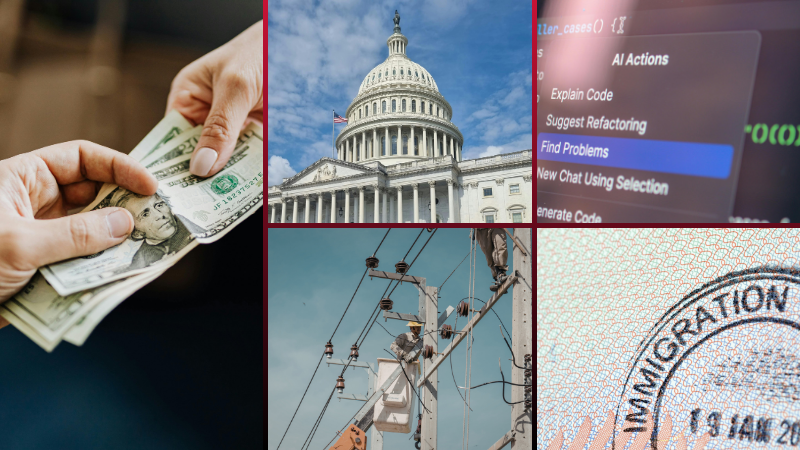
Now, with healthcare costs soaring and food inflation proving more stubborn than many expected, households will be pressed all the more to curtail their spending on non-essentials. Already, 1 in 3 consumers are cutting back on dining out.
Foodservice outlets will have to find new ways of offering value without going broke. That, in turn, will put pressure on vendors to provide lower-cost options that don’t pack an appreciable decline in quality.
It wouldn’t be such a challenge for the supplier community if its labor, healthcare, and energy costs weren’t galloping along with operators’ expenses.
Technology offers some relief, but only some. The year could pose the toughest sales challenge manufacturers and operators have faced since the pandemic.
What about MAHA?
The industry was braced for an upending when MAGA embraced MAHA as a core policy. How strident would Robert F. Kennedy, Jr., be in changing the way America eats? Would that leave restaurants pinched between what consumers want to eat and what the federal government says the public should be served?
The fears have proved largely unfounded to date. Yes, operators in Texas and West Virginia are rewriting their recipes to omit ingredients those states have banned or flagged as must-avoids, like artificial dyes. But those actions have come at the state level. Relatively little change has been mandated on a national scope.
The question is, Will that pattern hold?
Next month, the U.S. Departments of Agriculture and Health and Human Services (HHS) are likely to release the new federal Dietary Guidelines, the standards that influence America’s dining habits in countless ways. A definition of “ultra-processed foods” is also in the works. The release of either official guideline could be when the saturated fat hits the fan.
HHS isn’t waiting for the guidelines’ release to start telling Americans what not to eat. It recently posted an image of Franklin the Turtle, a cartoon character popular among children, shopping in a supermarket. The bespectacled reptile is pushing a cartful of whole vegetables and cuts of meat past shelves laden with chips, seed oils, sugar, and candy. The headline reads, “Franklin avoids ultra-processed foods.”
A curious tidbit: Franklin is Canadian.
What if AI is all it’s cracked up to be?
The conga line of celebrating food-away-from-home professionals will likely stretch from New York to L.A. After eons of agonizing over how to find enough manpower to run farms, factories, kitchens, and dining rooms, the industry would finally get some relief.
Rote jobs could be mechanized with reasonable assurance the business won’t be tipped into catastrophe. And managers would have a brilliant backup when making the gazillions of weighty decisions they face on a routine basis.
Of course, we have a long way to go before getting there. Right now, AI is still more of a promise than a revolutionary advance, at least in the food-away-from-home business.
Which leads to one more prediction for 2026: A major objective of managers will be learning how to craft the best input prompts for whatever AI platforms or tools they use.
What’s up with utility costs?
As if operators needed more inflationary pressure on menu prices, they readily got it from an unexpected source: utility costs. The National Restaurant Association reported in its 2025 State of the Industry report that 83% of restaurateurs now view the cost of electricity and gas as a significant expense. Credit-card swipe fees, long a major complaint of operators, were cited as significant by 81% of the respondents.
For much of the past, some operators didn’t even break out utility costs on their P&Ls. The expense was lumped into Occupancy Costs or the catch-all Other. Why the spike?
The answer usually given is increased demand for electricity, a result of having more alternatively powered cars on the road and the need to accommodate AI. The latter technology needs more power per se, and the processing requires a near-frigid environment. Providing the chill devours so much energy that some tech concerns are looking to put nuclear reactors in space to provide it.
Last week, President Trump committed to having those reactors in orbit and on the moon by 2030.
What if aggressive immigration enforcement continues?
What started as a worrisome labor issue has metastasized into a significant damper on sales and traffic.
Foreign-born consumers, here legally or not, are reluctant to dine outside their homes because of fears they’ll be swept into a nightmare by ICE commandos. At best, operators report, their Hispanic customers are shifting to delivery, so they don’t have to leave their homes, or the drive-thru, since exposure is presumably lessened.
Meanwhile, the industry continues to be vexed by the impact on labor. Reports of local ICE activity have triggered a sharp increase in call-outs and no-shows, as even documented workers decline to run the risk of having to defend their legality.
Trump had indicated several months ago that he might entertain ways of allowing nondocumented aliens to work in hard-pressed businesses for a limited time, but he hasn’t mentioned the possibility in more recent weeks.
Got a what-if we’ve missed? Let us know your thoughts.